How free gym apps usually pay for themselves
Building and maintaining an app costs money, so a free app is always paid for somehow. It helps to know how before you commit a year of training to one.
- Ads. Banners on your log, or full-screen videos between screens. In a gym app those land between sets, when your hands are sweaty and you have 90 seconds of rest.
- Freemium limits. The basics are free. The parts you come to rely on after a few months, like full history, progress charts, export or more than a handful of routines, sit behind a subscription.
- Trials. Everything works for 7 or 14 days, then the app asks for a card.
- Data. An account with your age, weight and training habits is valuable to advertisers and partners.
- Tips. The app is free for everyone, and people who like it can chip in.
Only the last model costs you nothing in features, attention or privacy. It's also the least common.
A 5-minute check before you install
| Check | Where to look | What to look for |
|---|---|---|
| Ads | Store listing, under the app name | Google Play shows a "Contains ads" label |
| Purchases | Store listing | An "In-app purchases" label is common. Find out what they unlock |
| Subscription | Description, screenshots, reviews | Pro, Premium, Plus, or "unlock everything" |
| Data | Data safety section on Google Play | What's collected, what's shared, and why |
| Account | First launch | A sign-up wall before you can log anything |
| Export | Settings | Whether your history can leave the app, and whether that costs extra |
Recent reviews are worth a scroll as well. If an app moved a feature behind a paywall last month, the one-star reviews will say so.
The features that tend to get locked
Logging a set is rarely the paid part. What ends up behind a subscription is usually whatever becomes valuable after you've used the app for a while:
- Progress charts beyond the last few weeks
- Your full workout history
- Estimated one-rep max and other stats
- Unlimited routines or exercises
- Export to CSV or a backup file
That's why it pays to check early. Three months in, your history is exactly what you'd lose by leaving, and that's often when the upgrade screen appears.
If you're switching from a paid app
Moving apps doesn't have to mean throwing your history away. Before you cancel a subscription, check whether your current app can export your workouts, and do it while you still have access. Even if no other app can import the file, a CSV of your old sets is worth keeping. It's your training history, and any spreadsheet will open it.
Then write down your current working weights for each exercise. Start the new log from those real numbers, and from your second session on, "last time" shows you something worth beating. You lose a few weeks of chart, not months of momentum.
What free looks like in Mooskles
Mooskles has no trial, no Pro tier and no subscription. Every feature is in the free app:
| Feature | Price |
|---|---|
| Workout planner with colour-coded sections | $0 |
| Gym log: weight × reps, reps only, time or a plain tick | $0 |
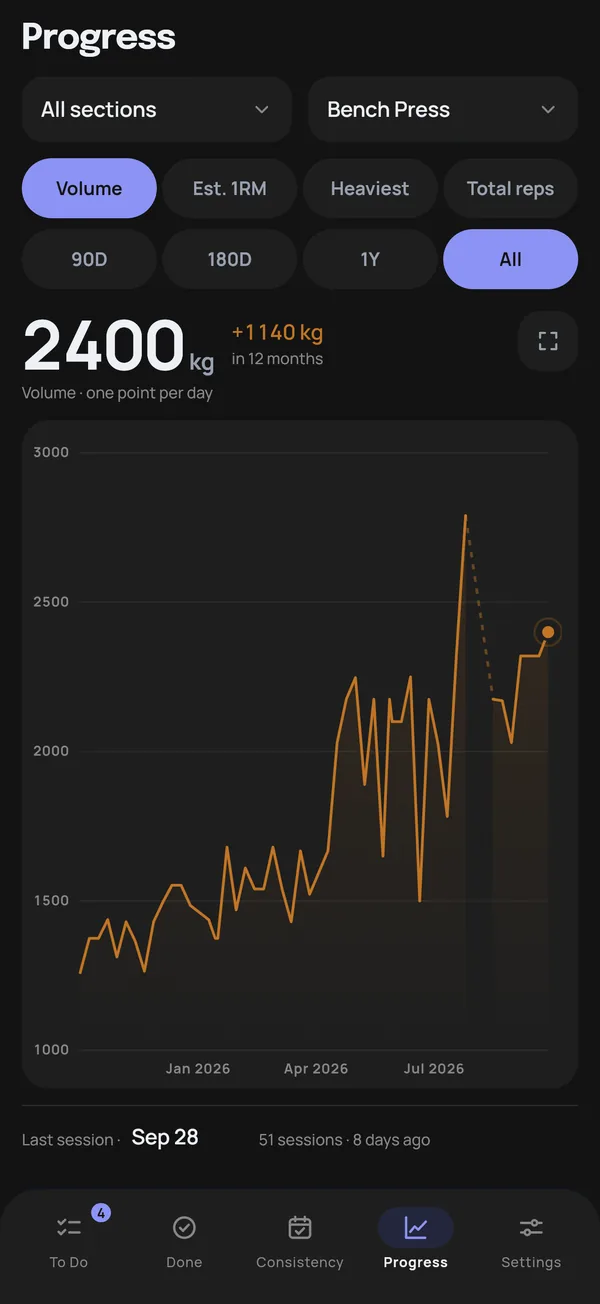
| Progress charts: volume, estimated 1RM, heaviest set and total reps, back to day one | $0 |
| Consistency tracking and the Showed up grid | $0 |
| Body measurements: weight, body fat, muscle and waist | $0 |
| Backups, CSV export and CSV plan import | $0 |
| Account, ads, subscription | None |
If Mooskles earns its spot on your home screen, you can leave a tip from Settings. It unlocks nothing, because nothing is locked. The payment goes through Google Play and our payment provider, and your workout data stays on your phone either way.
Mooskles is on Google Play now, and the iPhone and iPad version is on its way.
Why ads hurt more in a gym app
An ad in a news app costs you a second of scrolling. In a gym app it lands at the worst moment. You've just finished a set, you're breathing hard, and you want to type two numbers and put the phone down. A full-screen ad turns a five-second job into a thirty-second one, several times a session.
Ads also tend to come with tracking. To show targeted ads, an app typically uses your phone's advertising ID and shares data with ad networks. Mooskles has no ads and no advertising ID, and it doesn't run analytics or crash reporting either. There's more on that in workout logging without an account.
Free and offline go together
An app with no ads and no account has little reason to need the internet, which is handy in a basement gym. Everything in Mooskles works offline except leaving a tip. Our offline workout tracker guide shows how to test any app for this in about a minute.
Once you've picked an app, the next step is using it well. A good place to start is how to track progressive overload.
Every Mooskles feature is free, and the only purchase is an optional tip. Free, offline, no account, no ads.
Get Mooskles