Why leg day is the one that goes
Skipping leg day is a gym cliché for a reason. It's the session most likely to lose a fight with a busy week, and the reasons are easy to recognise:
- It's the hardest session. Squats, deadlifts and lunges work the biggest muscles you have. You finish out of breath, and the soreness can make stairs interesting for two days.
- The payoff feels slower. You notice your arms and chest in the mirror every day. Bigger legs are easier to overlook, so the reward for showing up feels smaller.
- The equipment is a barrier. The squat rack is busy, or a heavy barbell lift on a crowded floor feels like a performance.
- It sits at the end of the week. Plenty of plans put legs on Friday, the day most likely to be eaten by everything that went wrong on Monday to Thursday.
And then there's the quiet enabler: the way most of us keep score. Most workout apps only count what you did, not what you owe. Three solid upper-body sessions look like a great week. The missing leg day leaves no trace, so there's nothing to feel bad about and nothing to fix.
Leg day is just the famous example
The same pattern hits whatever you like least. For some people that's back day. For others it's core work, mobility, calves or the cardio finisher at the end of the plan. Everything below works the same way for those. Swap "legs" for your own least favourite session as you read.
1. Put legs first in the week
Train legs at the start of your week, while you're rested and before the week has had a chance to go sideways. If your week starts on Monday, Monday is leg day. A skipped Monday session also leaves you the rest of the week to make it up, whereas a skipped Friday session usually just disappears.
2. Make the session smaller
A 40-minute leg day you actually do beats a 90-minute one you keep putting off. Cut the plan back to four exercises and around ten working sets:
| Exercise | Sets | Why it's there |
|---|---|---|
| Squat or leg press | 3 | The main lift for your quads and glutes |
| Romanian deadlift | 3 | Hamstrings and glutes |
| Leg curl | 2 | More hamstrings, with little to set up |
| Calf raise | 2 | Quick, and easy to finish on |
If the barbell squat is the barrier, use the leg press for a while. A machine you'll use beats a lift you avoid. You can add volume back once the habit has held for a couple of months. If legs are part of a split, our push/pull/legs planner shows how the leg day fits with the rest of the week.
3. Take the edge off the soreness
The soreness is worst when legs are trained rarely. Every long gap means starting over, and the first session back hurts the most. Train them every week, start lighter than your ego wants, and the soreness after each session usually becomes much milder within a few weeks. Skipping legs to avoid soreness keeps the soreness around.
4. Keep skipped sets on the books
This is the fix most plans are missing. Track what you owe exercise by exercise, and don't let extra work elsewhere cover a hole.
Here's why that matters. Picture a 40-set week with 10 of those sets on legs. You skip leg day, but you feel good on Saturday and do a 10-set arm session instead:
| How you keep score | What it says |
|---|---|
| Workouts this week | 3 of 3. Perfect week |
| Total sets this week | 40 of 40. Right on target |
| Sets owed per exercise | Legs: 10 sets behind. Arms: 10 ahead, which doesn't help your legs |
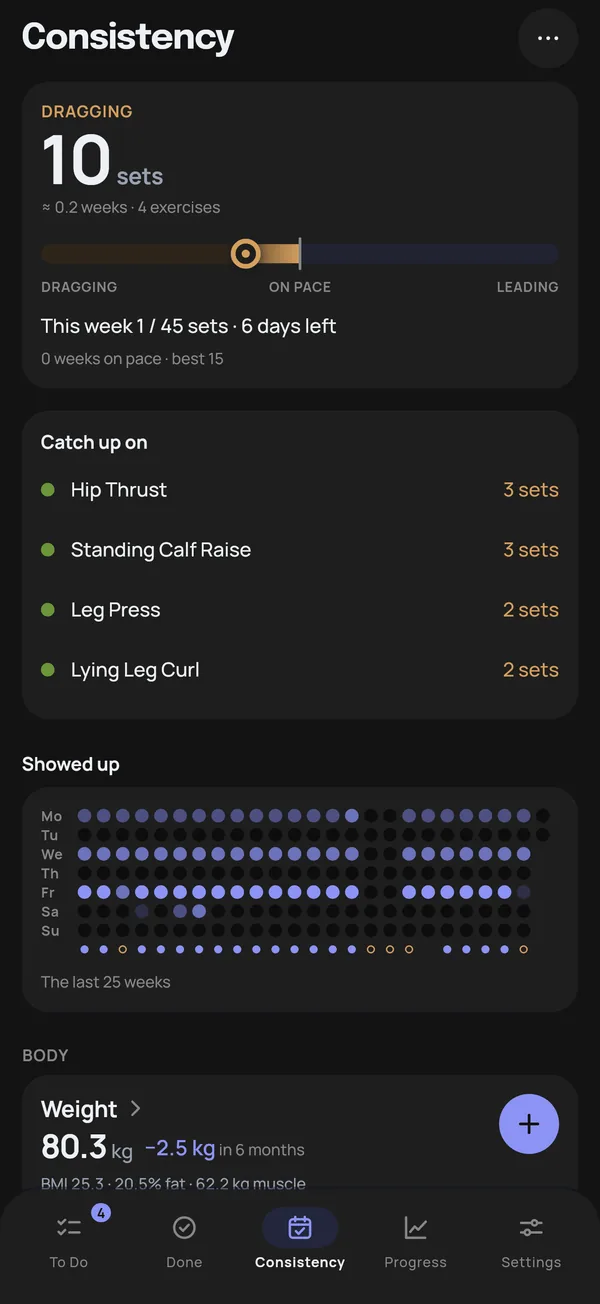
Only the last row tells the truth. That's how the Consistency tab in Mooskles keeps score. Each exercise owes its planned sets every week. Unfinished sets carry over as owed, and extra sets on one exercise never pay off another. Skip leg day and every leg exercise shows up under Catch up on, with the number of sets it's waiting for.
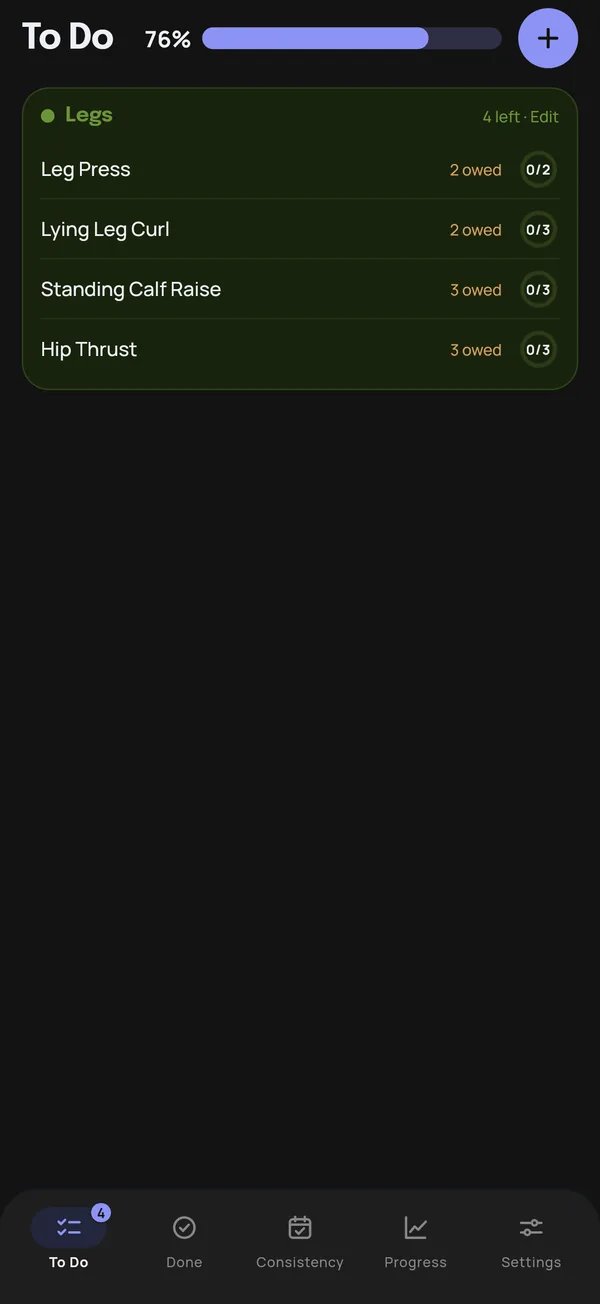
The debt follows you into your plan too. In the To Do tab, each leg exercise carries an "owed" marker until you pay it back. New leg sets clear the oldest debt first, so last week's leftovers are settled before this week's list.
Consistency is off until you switch it on, and it only reads what you log. It never moves or resets anything in your plan. There's a full explanation of the rules in how a workout accountability ledger works.
5. Look for the pattern
One skipped leg day is a bad week. The same skip every other week is a planning problem. The Showed up grid in Mooskles lays your training days out in weekday rows, so a pattern like "Fridays are always empty" jumps out. If the empty day is the one your legs live on, move leg day rather than trying harder.
When you really can't train legs
Injuries and illness happen. Don't train through pain to clear a number on a screen. Archive the exercises you can't do: an archived exercise owes nothing, and its balance stays hidden until you bring it back. After a longer break, Fresh start clears everything owed and banked and makes the rest of the week a warm-up, while keeping your past weeks and best streak.
When you come back, don't try to repay two weeks of leg work in one session. Spread the owed sets over your next few leg days and let the number come down steadily.
In Mooskles, a skipped leg day stays on the books until you train legs. Free, offline, no account, no ads.
Get Mooskles