What goes on each day
The split groups muscles by the movement they do. Pushing muscles work together on presses, and pulling muscles work together on rows and pull-ups, so each session trains muscles that already cooperate. It also means one day's training barely touches the next day's muscles, which is why PPL can run on consecutive days.
| Day | Muscles | Example exercises |
|---|---|---|
| Push | Chest, shoulders, triceps | Bench press, overhead press, incline dumbbell press, lateral raise, triceps pushdown |
| Pull | Back, rear shoulders, biceps | Pull-up or lat pulldown, barbell or cable row, face pull, biceps curl |
| Legs | Quads, hamstrings, glutes, calves | Squat or leg press, Romanian deadlift, leg curl, hip thrust, calf raise |
Core work fits on any day. A plank or hanging leg raise at the end of leg day is a common choice.
Choose a schedule you can keep
PPL is flexible about frequency, which is a big part of why it's so popular. There are three common versions:
| Version | Week | Good for |
|---|---|---|
| 3 days | Mon Push · Wed Pull · Fri Legs | Busy weeks, beginners, anyone getting back into it |
| 6 days | Push · Pull · Legs · Push · Pull · Legs · rest | People with the time and recovery to spare |
| Rolling | Push · Pull · Legs · rest, on repeat | More than 3 days a week without committing to 6 |
The 6-day version trains each muscle twice a week, which many lifters find works better for growth than once. It's also the version people abandon first. If you're unsure, run three days for a month. Adding sessions to a habit that already sticks is easy. Rebuilding a habit after burning out is much harder.
The rolling version doesn't line up with calendar weeks, so plan it in rounds of Push, Pull and Legs rather than in weeks.
How many sets to plan
Each exercise needs a set count, not just a name. "Bench press" is a reminder. "Bench press, 4 sets" is a plan you can finish and tick off.
A reasonable starting point is 2 to 4 working sets per exercise and 4 to 6 exercises per day. That puts most sessions somewhere between 12 and 20 sets, which fits in an hour for most people. On a 3-day split, lean toward the higher end, since each muscle gets only one session a week. On a 6-day split you can do a little less per session, because you'll be back on the same muscles a few days later.
Put the heavy compound lift first while you're fresh, and leave the small isolation work for the end.
A sample 3-day PPL plan
| Push | Pull | Legs |
|---|---|---|
| Bench press · 4 sets | Lat pulldown · 4 sets | Squat · 4 sets |
| Overhead press · 3 sets | Barbell row · 3 sets | Romanian deadlift · 3 sets |
| Incline dumbbell press · 3 sets | Face pull · 3 sets | Leg curl · 3 sets |
| Lateral raise · 3 sets | Biceps curl · 3 sets | Calf raise · 3 sets |
| Triceps pushdown · 3 sets | Hammer curl · 2 sets | Plank · 3 sets |
Use a rep range like 6 to 10 for the first lift of each day and 10 to 15 for the rest, then add weight with the method in how to track progressive overload.
Setting it up in Mooskles
Mooskles plans in sections, and a PPL split maps straight onto them. Make a Push section, a Pull section and a Legs section, each in its own colour, and give every exercise its planned sets. The To Do tab then shows only what's left. Log an exercise's last set and it moves to Done.
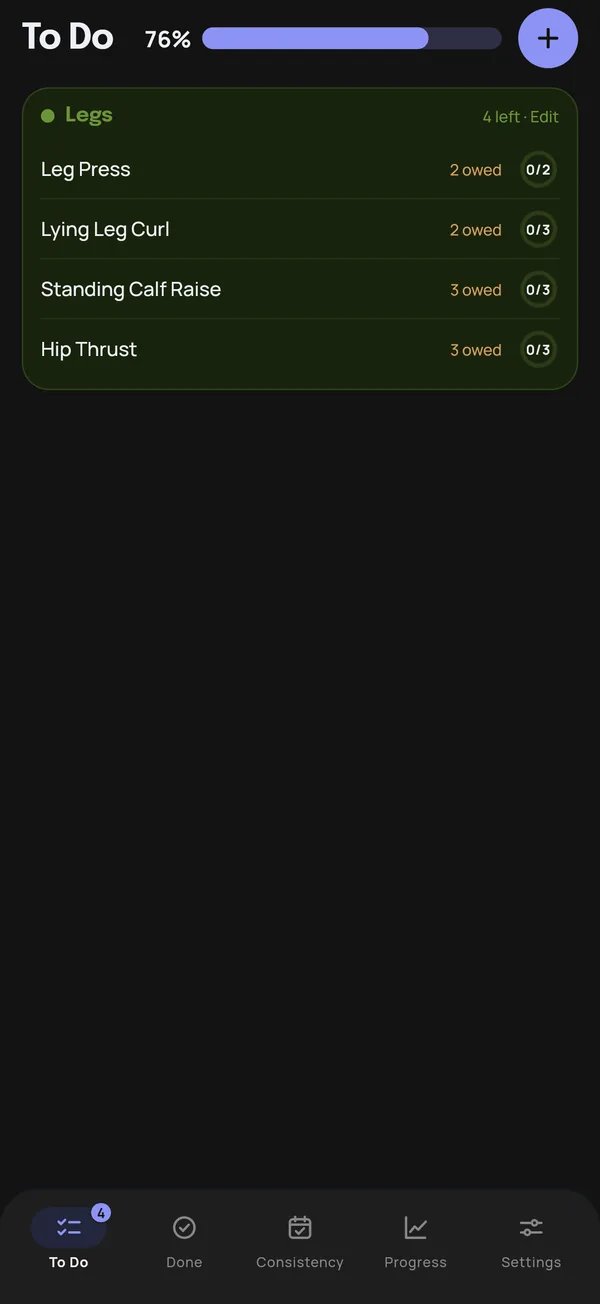
When the whole list is done, you start the next round yourself. Nothing resets behind your back, so a missed day doesn't wipe your progress through the week. The unfinished session just waits for you.
For the 6-day version, make six sections: Push A, Pull A, Legs A, Push B, Pull B and Legs B. The B days can use different exercises, or the same ones in a different rep range.
If you'd rather type the plan on a computer, fill in the CSV template from Settings and import it to create every section and exercise at once. Each row is one exercise:
section,exercise,tracking,sets
Push,Bench press,weight_reps,4
Push,Overhead press,weight_reps,3
Pull,Pull-up,reps_only,3
Legs,Squat,weight_reps,4
Legs,Plank,duration,3
The tracking column sets how each exercise gets logged: weight and reps, reps only, time (duration), or a plain tick (none).
What to do when you miss a day
On a split, a missed day means a muscle group goes an extra week without training. Don't skip ahead in the rotation. Do the day you missed, then carry on in order. If you missed Pull on Wednesday, Friday becomes Pull, and Legs moves to the weekend or the start of next week.
The optional Consistency tab in Mooskles keeps score of this for you. Unfinished sets carry over as owed, and extra push work never covers a skipped pull day. There's more on that in how to stay consistent at the gym. Legs is the day most people drop, so we wrote a separate guide on how to stop skipping leg day.
When to change the plan
Keep the same exercises for at least six to eight weeks. Swapping them every session makes it impossible to tell whether you're getting stronger. Change an exercise when it hurts in a bad way, when the equipment is always taken, or when your log shows it hasn't moved in a month despite steady training. Change the whole split when your schedule changes, not because you're bored.
Set up Push, Pull and Legs as sections in Mooskles, and the To Do tab shows exactly what's left today. Free, offline, no account, no ads.
Get Mooskles