Why showing up beats the perfect program
A decent program done for a year beats a brilliant one done for six weeks. Strength and muscle come from repeating the same lifts often enough to get a little better at them, and that only happens if you keep turning up.
Most people who stall at the gym have an attendance problem that looks like a programming problem. They miss a few sessions, the numbers stop moving, so they switch routines and start fresh. Then the new routine runs into the same busy month as the old one.
The habits below are boring on purpose. Boring is what survives a busy month.
1. Plan a week you can finish on a bad week
The most common mistake is planning for your best week. Five sessions look great on Sunday night. By Thursday you've done two, you feel behind, and "behind" turns into "I'll restart next week".
Plan for an ordinary week instead, the one with a late meeting and a bad night of sleep in it. If you can reliably train three times, plan three sessions. If an hour is realistic, plan four or five exercises per session, not eight. You can add a session once the smaller plan has held for a month or two. Cutting back later feels like failing, even when it's the sensible move, so start small.
A useful test: could you still finish this week's list if one session got cancelled? If the answer is no, the plan is too big.
2. Give every session a day and a time
"Three times a week" is a wish. "Monday, Wednesday and Friday at 7am" is a plan. Fixed days remove the daily negotiation with yourself about whether today is the day, and that negotiation is where most sessions get lost.
Pick slots you can protect, then treat them like any other appointment. If a slot keeps getting eaten by work or family, move it to a time that survives rather than fighting for it every week.
3. Decide what you'll do before you walk in
Walking into the gym without a plan costs energy. You wander, you wait for a machine you didn't need, you do the exercises you like and skip the ones you don't. A written list for each session fixes that.
In Mooskles, each session lives in a colour-coded section (Push, Legs, whatever you call it), and the To Do tab shows only what's left. Finish an exercise and it moves to Done, so the next thing to do is always at the top of the screen. If you train on a push/pull/legs split, that's three sections and you're set up.
4. Lower the bar for a day that counts
Some days you'll be tired, sore or short on time. The all-or-nothing version of you skips. The consistent version goes and does less.
Set yourself a minimum session: the first two exercises, or 20 minutes, whichever comes first. Most days you'll end up doing more once you're warm. On the days you don't, you still kept the habit alive, and that matters more six months from now than one great workout.
The same goes for logging. If you can't face typing numbers, record that the set happened and move on. Mooskles has a Set done button for exactly that: the set counts toward your plan without you inventing a weight you don't remember.
5. Track showing up separately from performance
Your bench press won't go up every week. Some weeks it will go down. If the only number you track is performance, a flat week feels like proof you're wasting your time.
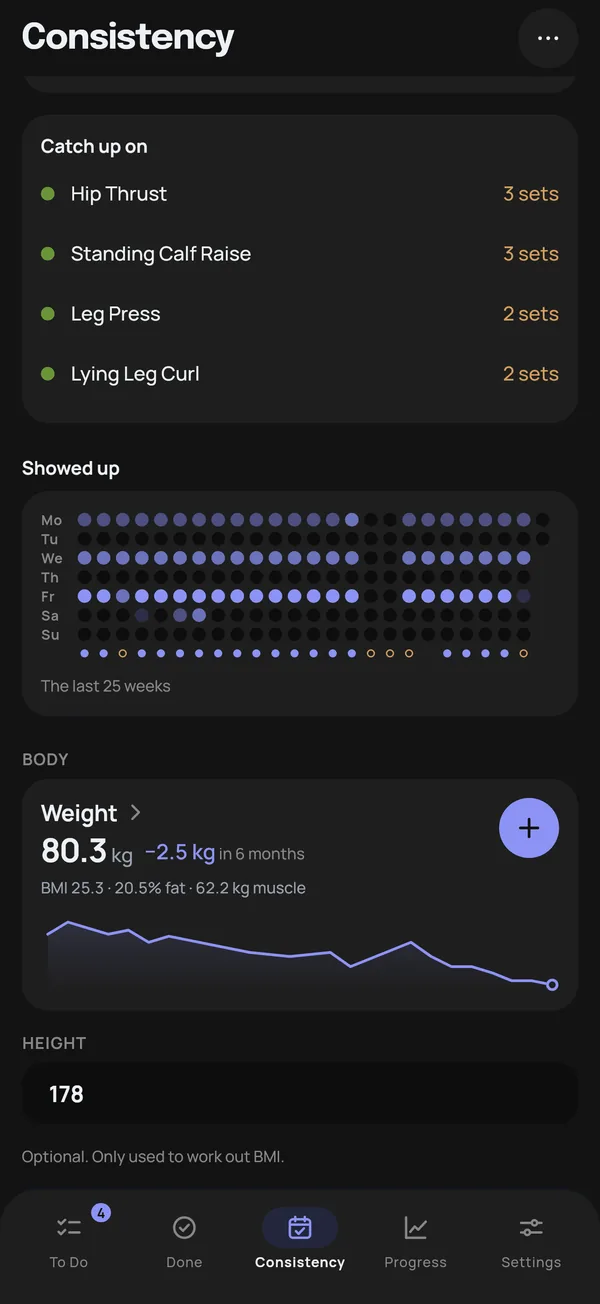
Attendance is different. You control it completely, and it's the number that drives everything else. Keep a record of which days you trained and look at it as a grid of weeks. Gaps jump out, and so do runs of solid weeks you'll want to protect.
6. When you miss a session, carry it over
This is where most streaks really die. You miss Wednesday, so the week is "ruined", so you might as well start fresh on Monday. That one missed session just cost you three.
A better rule: missed work rolls forward. If you skipped legs, legs is the next session, and the week isn't finished until legs is. You don't get to swap it for an extra chest day either, because extra bench press does nothing for your legs. If legs is always the session that goes, here's how to stop skipping leg day.
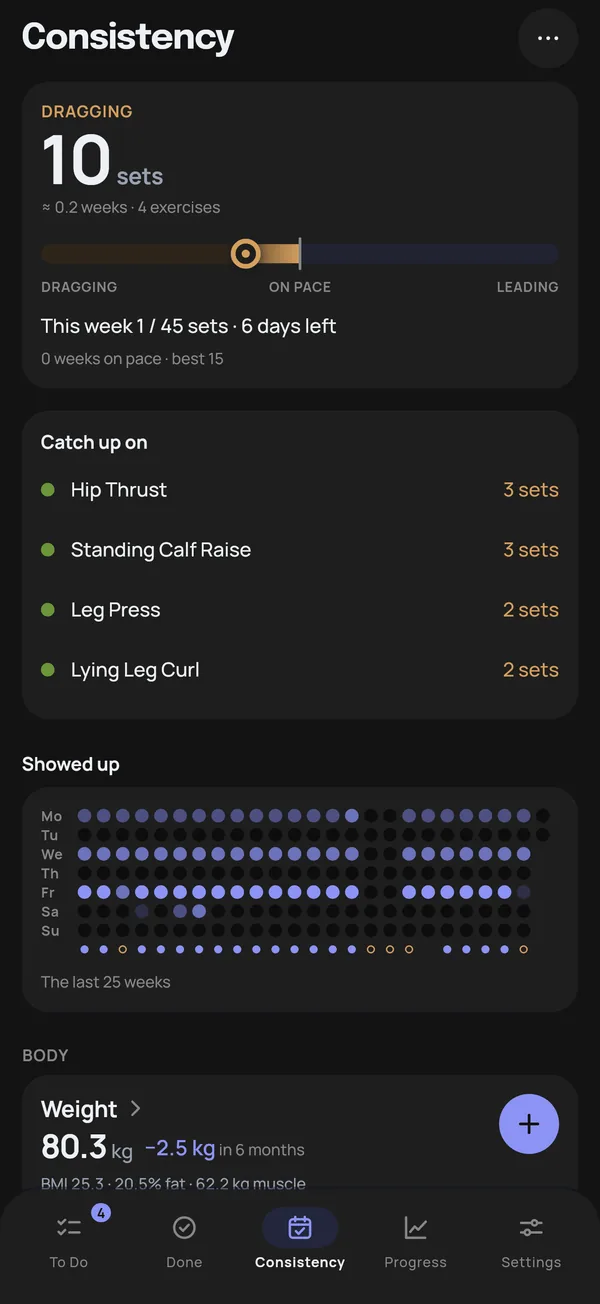
The Consistency tab in Mooskles is built on this rule. It's off until you switch it on. Once it's on, every week owes its list. Unfinished sets carry over as owed, extra sets on one exercise never pay off skipped sets on another, and a gauge shows whether you're dragging, on pace or leading. It only reads what you log, and it never moves or resets anything in your plan. Our guide to the workout accountability ledger walks through the full rules with an example.
7. Count weeks, not days
Daily streaks are fragile. One rest day you actually needed breaks them, and a broken streak is a great excuse to stop. A week either met its plan or it didn't. That's a fairer thing to keep score of, and it leaves room for real life inside the week.
Aim for weeks on pace and keep an eye on your best run. Beating your own record of good weeks in a row is a better motivator than any quote on a gym wall.
8. Let progress do some of the motivating
After a couple of months, consistency starts paying you back in numbers: more reps at the same weight, then more weight. Seeing that trend is one of the best reasons to keep going, so make sure you can see it. Our guide to tracking progressive overload covers what to log and which charts to watch. If you're also trying to change your body composition, tracking your weight and waist shows changes the mirror misses.
Getting back after a break
Illness, travel or a rough month will knock you off course at some point. When it happens, go back to the same plan with lighter weights for a week or two rather than writing a new one. Your log tells you exactly where you left off, which takes the guesswork out of the first session back.
Then do the boring thing again. Same days, same list, one week at a time.
Mooskles keeps your plan, your log and your weekly pace in one place, so you always know what's owed. Free, offline, no account, no ads.
Get Mooskles