Why the scale lies a little every day
Your body weight moves around from one day to the next for reasons that have nothing to do with fat or muscle:
- Water. A salty dinner, a hot day or a hard workout can shift how much water you hold overnight.
- Carbs. Muscles store carbohydrate along with water, so a high-carb day can show up on the scale the next morning.
- Food in transit. Yesterday's meals still weigh something until they're digested.
- Hormones and sleep. Stress, poor sleep and the menstrual cycle all change water retention.
A swing of a kilo or more (two or three pounds) between one morning and the next is normal. If you judge progress on one weigh-in, a good week will regularly look like a bad one.
The scale also misleads in a second way. If you're new to lifting, or coming back after a long break, you can lose fat and build muscle at the same time. Your weight barely moves, your clothes fit differently, and the scale says nothing happened.
What to measure, and how often
| Measurement | How | How often | What it tells you |
|---|---|---|---|
| Body weight | Morning, after the bathroom, before food or drink, same scale | 3 to 7 times a week | Overall direction, once averaged |
| Waist | Tape at the navel, relaxed, after a normal breath out | Weekly or fortnightly | Fat lost or gained around the middle |
| Body fat % | Smart scale or similar device, the same one each time | With your weigh-ins | A rough trend, not an exact figure |
| Muscle mass | The same device as body fat | With your weigh-ins | A rough trend over months |
Measuring the same way every time matters more than precision. A cheap tape used the same way every week tells you more than an expensive scan done once.
Getting the waist measurement right
Stand up straight, breathe out normally, and wrap the tape around your waist at the level of your navel. Keep it snug against the skin without pressing in, and level all the way round. Don't suck in. Take two readings and average them if they differ. Measure at the same time of day each time, ideally in the morning alongside your weigh-in.
A word on body fat readings
Most smart scales estimate body fat by passing a tiny electrical current through your body and measuring the resistance. Hydration has a big effect on that reading, so the same person can see a difference of a few percentage points on the same day. Use the number as a trend over months, from the same device, under the same conditions. Don't compare it with a reading from a different scale or the machine at your gym.
How to read the trend
Look at weekly averages or a chart, and read weight and waist together. The pair tells you much more than either number alone:
| Weight | Waist | Likely meaning |
|---|---|---|
| Down | Down | You're losing fat |
| Steady | Down | You're losing fat and gaining muscle |
| Up slowly | Steady | You're gaining mostly muscle, if you're training hard |
| Up | Up | You're eating more than you need, and some of it is stored as fat |
Give any change three or four weeks before you react to it. Two weeks of data is mostly noise.
Keeping body measurements in Mooskles
Mooskles logs weight, body fat, muscle and waist, and charts them over 90 days, 180 days, a year or all time. Every entry keeps its date, so you can scroll back and see exactly what you measured and when. Weights show in kilograms or pounds. Switching units relabels your history and never changes the values you stored.
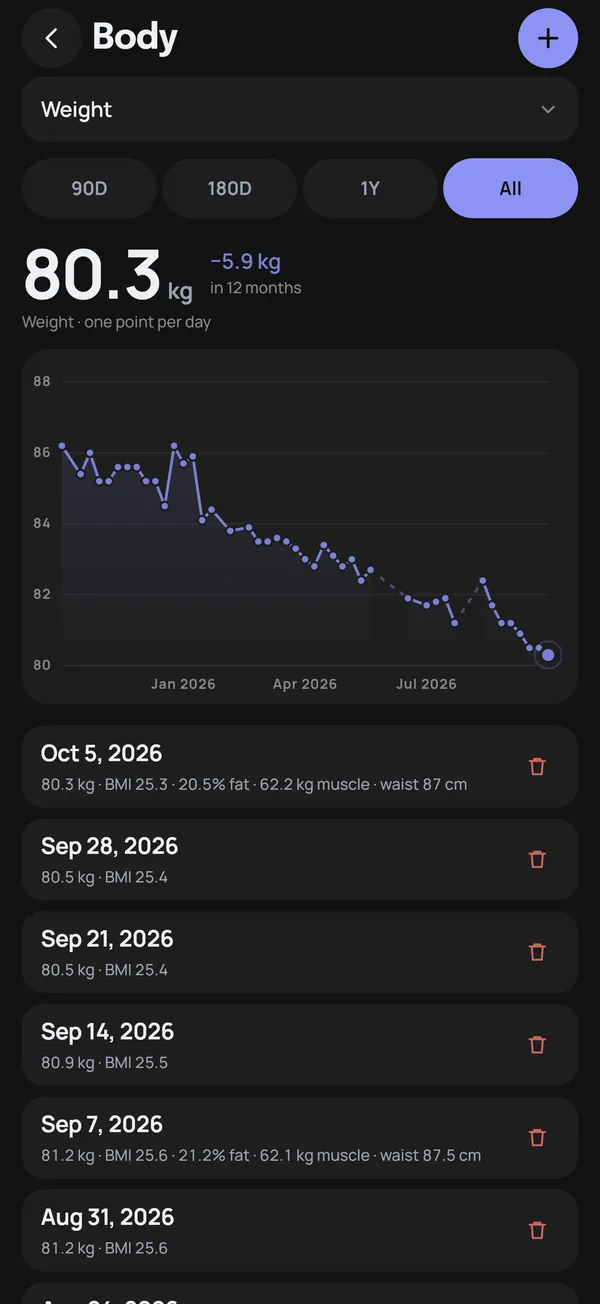
If you add your height, which is optional, the app also works out your BMI. BMI can't tell muscle from fat, so for anyone who lifts it's context at best. Your waist and the trend in your weight are better guides.
Your body stats sit on the Consistency tab, under the Showed up grid of your training days. When the weight chart does something odd, the grid above it often explains why: a holiday, a sick week, a run of missed sessions. There's more on building that attendance habit in how to stay consistent at the gym.
Pair body numbers with training numbers
Body measurements tell you what's changing. Your training log helps explain why. If your weight is steady while your lifts keep climbing, you're probably building muscle. If your lifts stall while your weight drops quickly, you may be eating too little to recover. Our guide to tracking progressive overload covers the training side.
Measure the same way, at the same time, for a few months. The trend will be clear long before any single number is.
Mooskles charts your weight, body fat, muscle and waist right next to your training. Free, offline, no account, no ads.
Get Mooskles