What progressive overload means in practice
Progressive overload is the idea that training has to get a little harder over time for your body to keep adapting. There are several ways to make it harder:
- More reps at the same weight.
- More weight for the same reps.
- More sets of the same exercise.
- Longer holds on planks and other timed exercises.
Memory is a bad tool for any of this. Without a record, you either repeat the same weights for months or jump too far and miss reps. Tracking turns "a bit harder" into a specific target for today.
What to write down for each set
For most lifts, two numbers are enough: the weight and the reps. Log your working sets, the ones that count, and leave warm-ups out unless you like the clutter. The date matters too, because how often you train an exercise is part of the story.
Some exercises don't fit weight × reps. Pull-ups and push-ups are reps only until you strap on extra weight. Planks and holds are measured in time. A good log lets each exercise track what makes sense for it, so you aren't typing a fake "0 kg" every time you do dips.
A simple method: double progression
Double progression is the easiest system to run from a log, and it suits beginners and intermediates alike. Pick a rep range for each exercise, for example 3 sets of 8 to 12.
- Start with a weight you can lift for 8 clean reps on every set.
- Each session, try to add a rep to at least one set.
- When all three sets reach 12, add the smallest jump your gym allows. On a barbell that's often 2.5 kg or 5 lb.
- Drop back to 8 reps with the new weight and climb again.
Here's how that plays out on a bench press over five sessions:
| Session | Weight | Set 1 | Set 2 | Set 3 | Next time |
|---|---|---|---|---|---|
| 1 | 60 kg | 10 | 9 | 8 | Beat the 9 and the 8 |
| 2 | 60 kg | 11 | 10 | 9 | Keep climbing |
| 3 | 60 kg | 12 | 11 | 10 | Nearly there |
| 4 | 60 kg | 12 | 12 | 12 | Add 2.5 kg |
| 5 | 62.5 kg | 9 | 8 | 8 | Start the climb again |
You never have to decide anything at the gym. The log sets the target, and the only question is whether you beat it.
Make last time impossible to miss
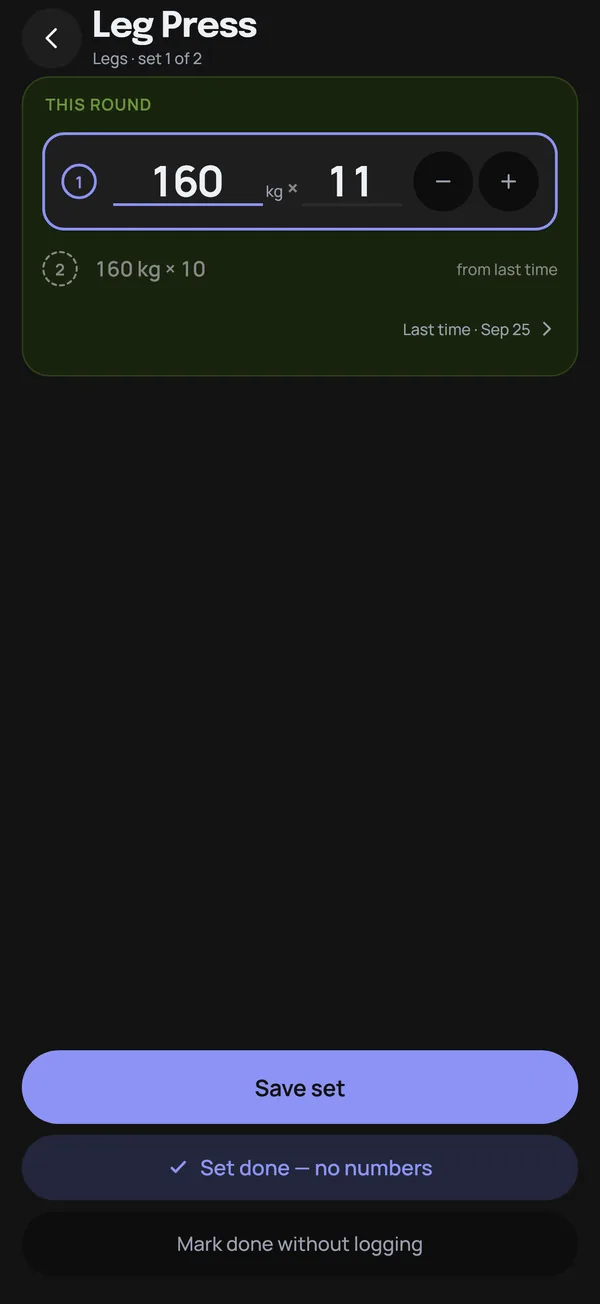
The most useful thing a log can do is put your previous numbers in front of you before you lift. A notebook does this if you flip back a page. A spreadsheet does it if you can find the right row on a phone screen between sets.
Mooskles fills in last time's numbers for you, so logging a set is a nudge and a save. Tap + to beat them by a rep, save, and get back to the bar. If you'd rather not count on a given day, Set done records that the set happened without any numbers, and it won't drag your charts down with a fake zero.
Which progress chart to watch
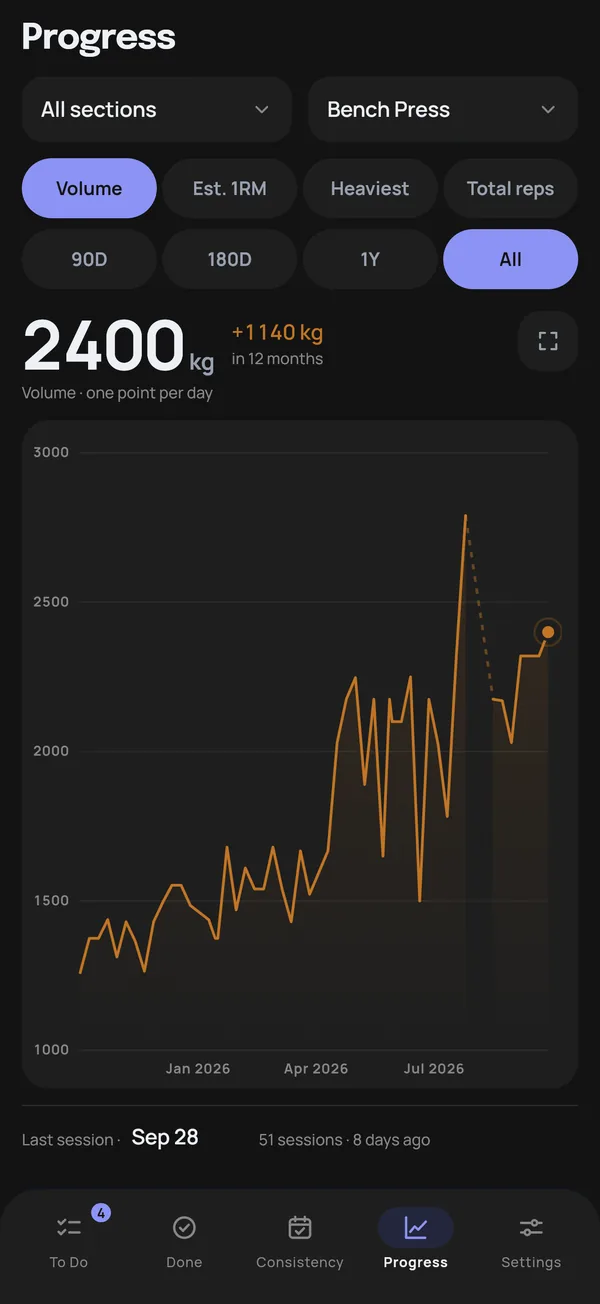
Numbers from one session to the next are noisy. Sleep, food and stress push them around. Over a few months, though, the trend should point up, and a chart shows that far better than a column of numbers. Different metrics answer different questions:
| Metric | What it is | Watch it when |
|---|---|---|
| Volume | Weight × reps, added up across the day's sets | You train for size and work in rep ranges |
| Estimated 1RM | The one-rep max your best set suggests | You care about strength but rarely test a true max |
| Heaviest set | The most weight you moved, for any reps | You do low-rep strength work |
| Total reps | Every rep of the day, no weight involved | Bodyweight exercises like pull-ups and push-ups |
Mooskles charts all four for any exercise, over 90 days, 180 days, a year, or everything since you started. Its estimated 1RM uses the Epley formula and only counts sets of 12 reps or fewer, because estimates from high-rep sets get unreliable. A true single counts as exactly the weight you lifted.
When the numbers stop moving
Everyone stalls eventually. Before you change your program, check these in order:
- Attendance. If you trained the exercise twice in the last month instead of eight times, that's the problem. See how to stay consistent at the gym, or let an app that tracks missed workouts keep count for you.
- Recovery. Short sleep and too little food will flatten any program.
- Rep range. If you've been stuck at the same reps for three or four sessions, try a lower range with more weight, or add a set.
- Fatigue. A lighter week, with fewer sets or less weight on the same exercises, often clears a stall on its own.
Your log matters here too. "I think I've been stuck for a while" is a feeling. "60 kg × 10 for five sessions running" is something you can act on.
Bodyweight and timed exercises
For bodyweight moves, reps are the main lever. Track total reps across your sets and push that number up before you add weight or move to a harder variation. For planks and other holds, track seconds. Mooskles gives timed exercises a stopwatch that fills in the time as it runs, so you don't have to remember when you started.
Spreadsheet or app?
Both work. A spreadsheet gives you full control over formulas and charts, and an app is faster between sets. We compare them honestly in gym log: spreadsheet vs app. Whichever you pick, the rule stays the same: write down every set, and look at it before the next one.
Mooskles fills in last time's numbers and charts every exercise, so you always know the rep to beat. Free, offline, no account, no ads.
Get Mooskles