
Most workout apps only count what you did
Open almost any gym log and you'll find a history of completed workouts, maybe a streak or a badge. All of it is built from what you did. The Wednesday you skipped doesn't appear anywhere. It's just a blank, and blanks are easy to ignore.
That's the gap. Nothing tells you the week came up short, by how much, or what you'd need to do to get back on track. Daily streaks go the other way: miss one day and the counter drops to zero, which feels so harsh that quitting starts to look reasonable.
What's missing is a running balance: what you planned, minus what you did, carried forward until you settle it.
Accountability when you train alone
A coach or a training partner works because someone notices when you don't show up. When you train alone, the app has to do the noticing. To notice a missed session, it needs to know what you meant to do, and that means your plan, with a set count for every exercise.
Mooskles already has that plan: your sections and exercises, each with its planned sets. Consistency reads it and keeps the books.
How the owed-sets ledger works
Think of it as a weekly bill, settled exercise by exercise:
- Every week owes its list. Each exercise owes its planned sets. An exercise with no set plan owes one Mark done.
- Leftovers carry over. If the week ends with sets unfinished, they become owed. Next week, the leftovers come first, then the whole list again.
- Extra work is banked. Do more than a week asks and the surplus counts ahead. That's leading.
- No covering. Each exercise settles its own account. Ten extra sets of bench press never pay off three skipped sets of squats.
Here's a 12-set weekly list over three weeks, with weeks running Monday to Sunday and tracking switched on on a Thursday:
| When | What happened | Gauge reads |
|---|---|---|
| Thu–Sun | Warm-up days: 6 sets done, nothing owed yet | Leading 6 |
| Week 1 | 6 more sets by Sunday. The 6 banked plus 6 cover the list | On pace, week kept |
| Week 2 | 9 sets done, squats (3 sets) skipped | Dragging 3, week missed |
| Week 3, Monday | 3 squat sets clear the old debt first | On pace, this week 0 / 12 |
| Week 3, Sunday | The whole list done again | On pace, week kept |
The big number on the gauge is always in sets, with a rough translation into weeks and the number of exercises involved underneath. Below that you get this week's progress, the days left, and your streak.
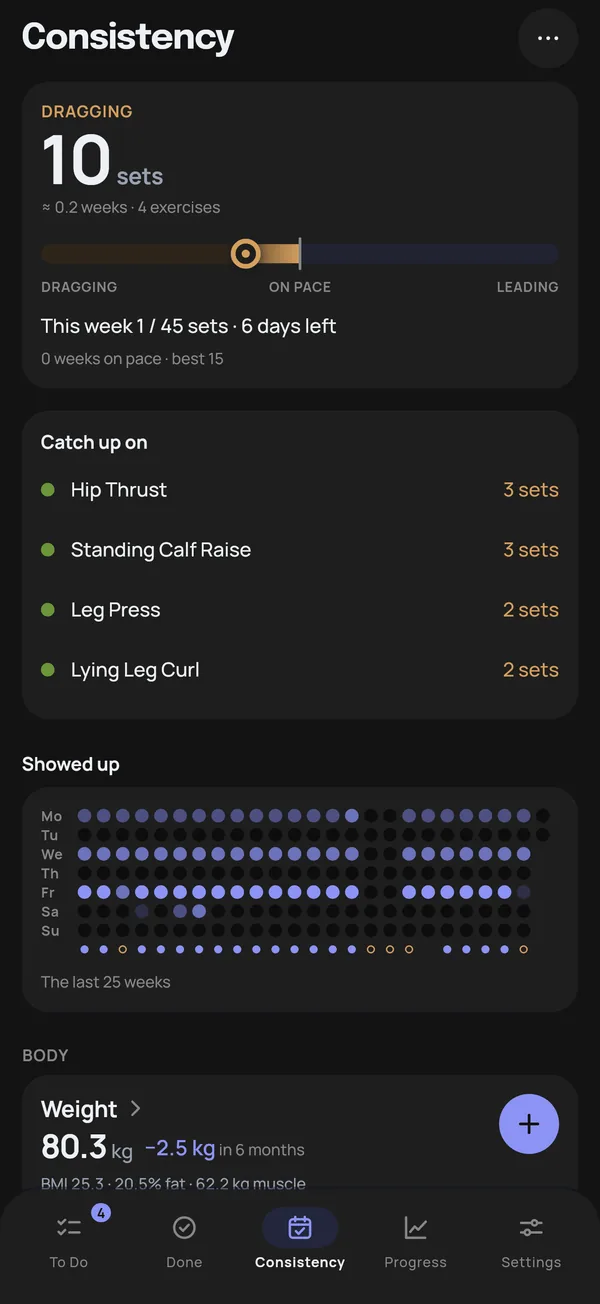
Under the gauge, Catch up on lists every exercise that's behind and by how many sets, and Ahead on lists the ones you've banked. In the To Do tab, an exercise carrying debt gets a small "owed" marker, so you see it while you plan the session.
How to catch up on missed workouts
Knowing what you owe is half of it. Paying it back sensibly is the other half.
- Don't cram. Doing two sessions of squats in one day after a missed week mostly buys you a bad session and a lot of soreness. Add owed sets to your next few sessions instead.
- Pay the same exercise back. If you skipped squats, do squats. Substituting something you prefer is how the hole stays open.
- Start with the oldest. The ledger already does this: new sets pay the oldest debt before this week's list.
- Reset when life happens. After an illness or a fortnight away, a big debt isn't motivating. Fresh start makes today your new starting point. Everything owed and banked is cleared, the rest of the week is a warm-up, and your past weeks and best streak are kept.
If you skip the same day over and over, that's a planning problem. Our guide on how to stop skipping leg day covers the usual culprit.
The rules that keep it fair
- It's opt-in. Consistency is off until you tap Start tracking and pick the day your weeks start.
- It starts with a warm-up. The days before your first full week count toward your balance, and nothing is owed until that first week ends. A newly added exercise gets the same grace.
- Plan changes aren't retroactive. Weeks that have already closed keep what they owed. A new set count applies from the current week on.
- Archiving pauses an exercise. It owes nothing while archived, and its balance is hidden until you bring it back. Deleting an exercise forgives its debt.
- Sets are what count. Every set you log pays toward its exercise, including a Set done with no numbers. Marking a planned exercise done without logging clears it from To Do, but it doesn't pay off any sets.
- It only reads. Consistency never moves, completes or resets anything in your plan.
The weekly streak and the Showed up grid
A week is kept when it ends with no exercise behind. Your streak counts kept weeks in a row, and your best run is remembered even through a fresh start. Weeks that owe nothing, like a holiday week with everything archived, are neutral: they neither grow the streak nor break it.
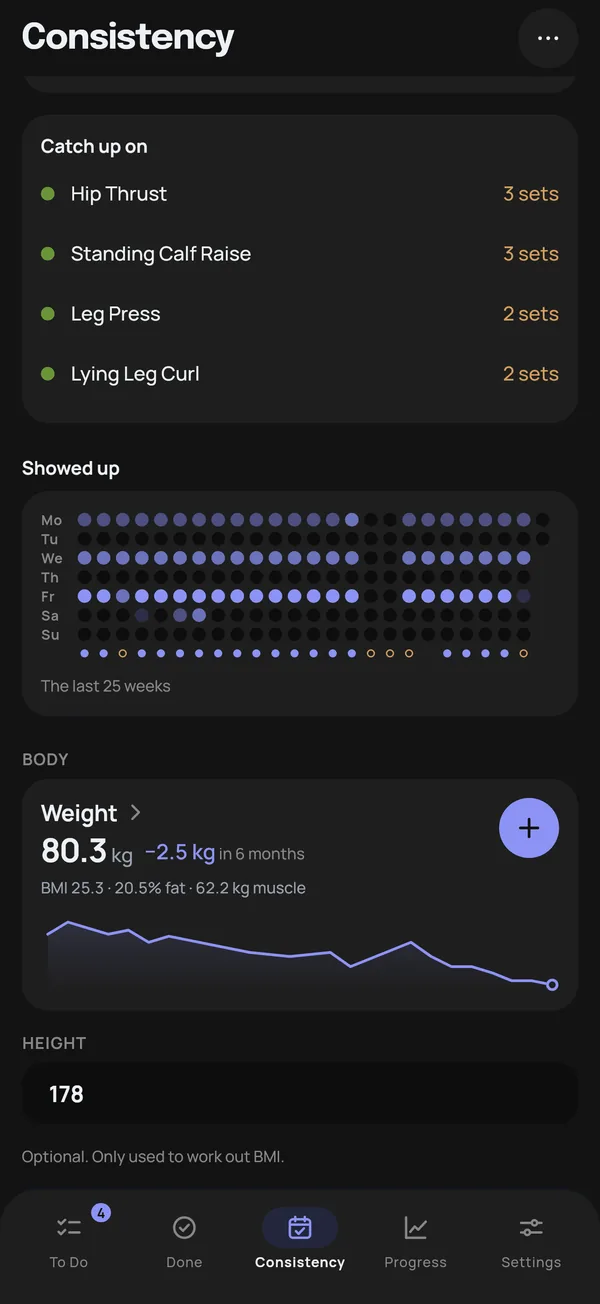
The Showed up grid sits on the same tab. It lights up every day you logged something, shaded by how much you did, with a marker under each week showing whether you kept up. It's built from your history, so it's there even before you switch tracking on.
Is a ledger right for you?
It suits people who follow a fixed weekly plan, train on their own, and drift without noticing. If your training changes every day, or the idea of owing sets stresses you out more than it motivates you, leave it off. The rest of Mooskles works exactly the same without it. For the habits that make any system work, start with how to stay consistent at the gym.
Mooskles counts what you owe as well as what you did, one exercise at a time. Free, offline, no account, no ads.
Get Mooskles